As parents, we often monitor our children’s height, weight, and academic progress, but how often do we check the alignment of their spine?
Scoliosis—a lateral curvature of the spine—often develops most rapidly during the adolescent growth spurt (typically between ages 10 and 15). The challenge for parents is that mild scoliosis is almost invisible from the front, especially when a child is wearing a loose school uniform or T-shirt. Early detection is the key to non-surgical management, yet many cases are missed until the curve has progressed significantly.
Does Singapore Screen for Scoliosis in Schools?
Yes. In Singapore, the Health Promotion Board (HPB) conducts annual health screenings in primary and secondary schools. Girls (who are statistically more likely to develop progressive curves) are typically screened for scoliosis starting in Primary 5 or 6.
However, a once-a-year check may miss a curve that develops rapidly between screenings. As a parent, you are the first line of defence.
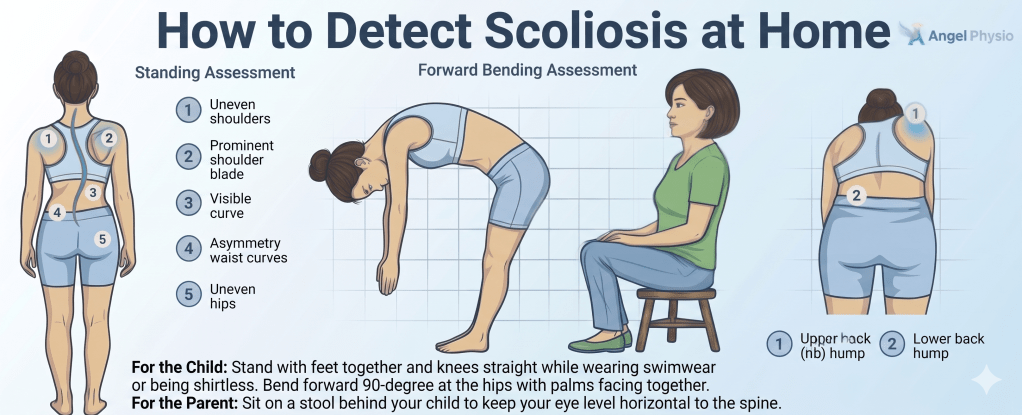
How to Check Your Child at Home: The 2-Step Screen
To get an accurate view, have your child wear swimwear or be shirtless so you can see the contours of the back clearly.
- The Standing Symmetry Check: Have your child stand upright with their back to you. Look for:
- One shoulder appearing higher than the other.
- One shoulder blade sticking out more prominently.
- An uneven waistline (one side looks more “curved” than the other).
- One hip appearing higher or more prominent.
- The Forward Bend Test (Most Important): Ask your child to join their palms and bend forward slowly, keeping their knees straight, as if reaching for their toes.
- The Positive Sign: Look for a “hump” or an elevation on one side of the back. Even a slight asymmetry in the height of the rib cage is a sign that you should seek a professional assessment.
Who Should You Consult?
If you notice any asymmetry, the first step is to confirm the diagnosis.
- The Specialist: You should consult an Orthopaedic Spine Surgeon or a specialist in paediatric spinal deformities. They will perform a clinical exam and determine if imaging is required.
- The Physio Role: Once a curve is identified, a Physiotherapist specialising in scoliosis (using methods like the Schroth Program) works alongside the specialist to strengthen the muscles supporting the spine and help minimise curve progression.
Angel’s Physio Tip: Early detection allows us to use proactive strategies like specific corrective exercises or bracing, which can often prevent the need for surgery later in life. If you haven’t checked your child’s back in the last six months, make this weekend the time for a quick 2-minute home screen.

 Angel Physio
Leave a comment